
Google’s Getting More Conversational. What’s That Mean For You?
Google’s recent announcement at their I/O conference confirmed what we all already knew was coming: they’re replacing their search with more AI, more conversation, and fewer lists of blue links. Now that past predictions are coming to fruition, it’s worth thinking about what these changes really mean for your organization.
tl;dr: if you run an association, healthcare organization, nonprofit, or a conscientious commercial company with impact and meaning behind what you do, this shift is more than likely working in your favor. Here’s why.
AI likes to EEAT
Google has long used a framework called E-E-A-T – Experience, Expertise, Authoritativeness, and Trustworthiness – to evaluate content quality. As AI takes on a bigger role in how search results are both generated and presented, this framework becomes more important. AI systems skew towards citing sources that are credible, consistent, and clearly know what they’re talking about.
This change benefits the majority of our clients, and likely your organization, too. You are very likely the authoritative source in your area of interest.
- Associations like SIOP and HRS are natural aggregate bodies representing industries, specialities and sectors.
- Healthcare organizations, like Inova and SGIM, often have heaps of certifications and accreditations across both the organizations and staff and are regularly contributing to advancing the body of knowledge in their areas of expertise.
- Nonprofits, like JDVS and OECM, are often some of the first to make information about an existing issue or cause available online.
- Commercial companies with novel products and services, like Ting and Spark Point, are often the first to share in-depth information about the problems they solve and why they are worth solving.
When a user asks an AI about Continuing Education requirements for a licensed profession, or who can provide EMDR therapy, or possible treatment options for a specific condition or issue, the AI wants to cite the organization that develops those requirements, certifies those therapists, or is a leader in researching and providing treatment for those conditions. That’s probably you.
From informational to transactional (the conversation spectrum)
For over a decade at Yoko Co, we’ve been talking about the conversational nature of search. Now, it really is a conversation. Those initial questions, when someone is oblivious or curious about a topic – “what is X?”, “how does Y work?”, “what are the requirements for Z?” – are being answered directly by AI. AI often cites the aforementioned authoritative sources without sending the user to your site (or, sometimes, even showing your site was cited). This is why, as we talked about last month, the drop in organic search traffic looks scarier than it actually is.
Sounds like bad news, right? Not entirely.
There’s still some benefit to being cited here. You know your information is being used to shape the greater conversation on this topic, and some users will still check cited sources and click through to engage. Others may ask natural follow up questions that you, again, are well positioned to answer, until they’re asking the questions that require action AI can’t do for them.
Those needs might be finding the right CE course for them to take, or the ideal product or treatment to solve their problem, or a certified provider or practitioner nearby to help with what ails them.
Directories & catalogs get a supercharge
For these kinds of queries, AI will continue to rely on EEAT-able sources. Right now, if a user asks AI “I need EMDR therapy, who should I contact?” it relies on those high credibility sources. In this case, one like EMDRIA.org.
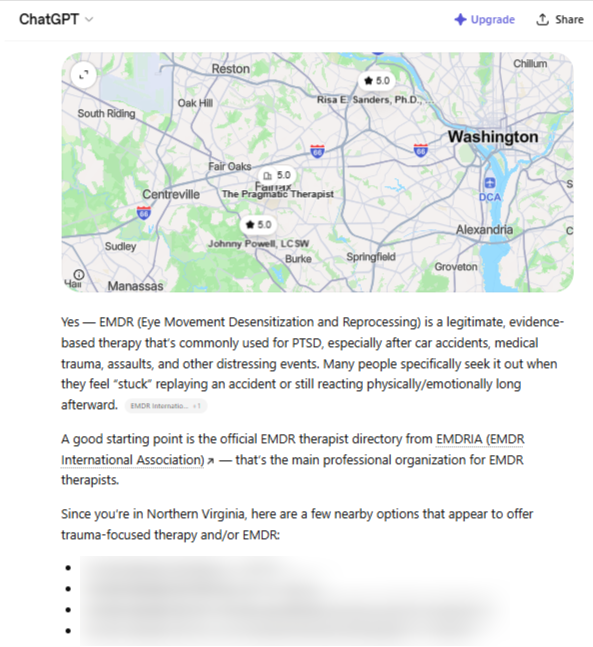
You’ll see that, currently, it simply suggests you go visit their EMDR therapist directory yourself. As AI becomes more adept at being able to ingest this information, it will start to use the directory or catalog for the user, and provide them with recommendations.
(Those of you having trouble getting members to fill out their profiles, feel free to use this carrot.)
The same will happen with products, treatments, and more. As AI is able to use these directories to search and index what is available, where it is located, how it applies, it will become increasingly good at providing a just-in-time recommendation to users to find what (AI thinks) they need at the time the user requests it.
How to make the most of this change
While many organizations have product catalogs and directories, they’re often an afterthought, as opposed to being considered as a driver of revenue, or member, customer, or patient benefit. Well-constructed sites enable pulling that data from its source (be it in a CRM, AMS, private community, inventory management system, etc.) into a format that makes it as easy as possible for AI to:
- Discover it – Schema fields with appropriate taxonomy and descriptions
- Ingest it – It has to be public, well structured accessible code
- Index it – The data needs to be cleanly structured and understandable
- Recommend it – It needs additional third party proof the thing is worth recommending (certifications, accreditations, licenses, reviews, publications, etc.)
This is why we’ve always built directories and catalogs for our clients (and we can do the same for you) in a way that maximizes accessibility, across all the ways that term applies. Ensuring they are performative and fast, intuitive and easy to use, and well coded and structured.
The web keeps evolving, and so do we
Despite the fact that social media loves a crisis and a doomloop, these changes to search are no cause for panic. They represent another step of the myriad already taken in humanity’s relationship with information and how we access it. In the long term, the organizations that thrive now will be the ones who double down on doing things the right way – by focusing on providing information that is genuinely useful to those they serve.
As always, if you have any questions about this topic and how it might impact you, we’re happy to connect and chat. Feel free to reply to this email, or reach out here.
We hope this helps!
Mahalo,
Chris & the Yoko Co team
–
PS – We’re heading to ASAE’s MMC+Tech Conference in Washington, D.C. on May 28–29 — and we hope you’ll be there too.
Ray van Hilst, Angie Busby, and Melissa Franko will be holding down booth 504 in the Expo Hall. Come say hello, pick their brains on accessibility, design, or strategy, and while you’re at it, drop your card to enter for one of five free Accessibility Snapshots ($750 value each). Everyone who enters gets a free Homepage Accessibility Review and our Top 10 Most Common Web Accessibility Hurdles guide sent straight to their inbox after the show.
Ray is also on a panel called “The Ultimate Website Redesign Survival Guide” – if a website project is anywhere on your radar, it’s worth your time.
Want the full scoop before you go? We did a whole Yoko Co Live on what to expect — check it out at yokoco.com/mmctech2026.
See you at 504.
—
What’s Good?
The latest impact stories from the worlds of our clients.
- A big step forward in cleaner battery production from Morehead-Cain Fellow Fadilullahi Ayodeji Adeniyi
- Our friends at the National Academy of Sciences working with their other S7 counterparts (the science academies of the G7 nations) on protecting the Arctic, managing satellite constellations, and improving brain health.
- We helped our friends at WWF-US launch the OECM Platform, a new global hub for Other Effective Area‑Based Conservation Measures (OECMs) – areas outside traditional protected areas that still make vital contributions to biodiversity conservation.
(We love good news, so if you have some, please contact us and use the form to share it with me!)
Latest Posts
Your website’s biggest audience isn’t people anymore
tl;dr: It was only a matter of time – machines are now visiting websites…

Your Association’s Website Has Three Jobs in 2026. Most Are Doing One and a Half.
My TikTok feed recently served up a video about well paying, in-demand careers that…
Do Less
Do Less. AI enables us all to do “more” – that’s the problem. You…
Keep Reading about Do Less