
It’s Not a Funnel. It’s a Conversation.
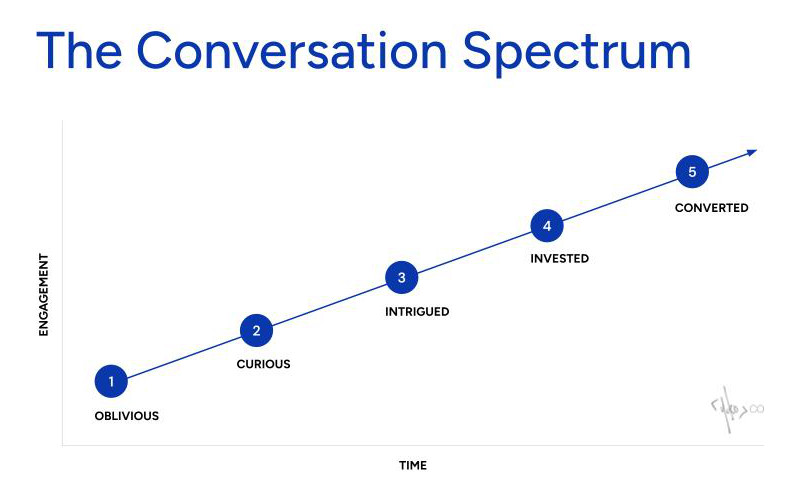
Most content, marketing, and sales models treat people as little more than gatekeepers of wallets to be harvested. The Conversation Spectrum treats people the same way you’d want to be treated if you were in the buyer’s seat. Like a conversation.
Let’s start with a headache.
The base of your skull starts to ache and you have no idea why. You don’t know what’s causing it, you don’t know what it’s called, and you certainly don’t know what to do about it. So you do what everyone does now – you search, or ask. Maybe you type “why does the base of my head hurt” into Google or ChatGPT.
You get some answers, and depending on what you see, you might click around and ask a few follow up questions. Before you know it, you’re trawling the depths of WebMD and the Mayo Clinic. After you’ve panicked yourself that it could be a rare form of cancer (thanks WebMD), you ultimately decide it’s a migraine, and you begin to explore remedies and treatments.
Congratulations! You’ve just gone through the Conversation Spectrum. Starting with an issue you were fairly Oblivious about, you became Curious, then Intrigued, to the point where you were ready to be Invested. In other words, you were prepared to put time, resources, and effort into it.
While the web has distorted our idea of what online interaction should look and feel like, we can all feel it when a website represents an organization that respects us, vs one that is attempting to trick or pressure us into giving them our time, money, or attention. Our clients are organizations that aim to do good in the world – they treat their clients, patients, members, customers, and, perhaps most importantly, a member of the public who may do nothing for them with respect.
There’s no tricks, or pressure, or misleading claims, popups, or countdowns. They treat each visitor to their site as if they were sitting across the table from them, having an actual conversation. And, as it turns out, this is a great model for brands and organizations that want to have long term relationships with audiences at scale built on trust and mutual respect.
We call the shape of this user experience the Conversation Spectrum.
Why it’s not a funnel
If this sounds similar to the Buyer’s Journey, AIDA, classic marketing funnel, or any of the dozen similar models out there, it is. While the steps and mechanics are very similar, the intention and spirit of the communications are significantly different.*
Most of those models, underneath the diagrams, treat a human being as something to be processed. Awareness, consideration, decision – move them along the conveyor belt, harvest the sale at the bottom, repeat. The unfortunate reality is that these systems work (they wouldn’t be as popular as they are if they didn’t) but they buy into a critical, de-humanizing flaw – which is seeing people as statistics. Production numbers that must go up and to the right.
There is no shortage of slick operators who will say whatever it takes to close. Who link to fake studies in their product descriptions, who harvest the single good review or testimonial out of several middling or poor ones, who are more than happy to leverage dark patterns to make a quick buck. You know the ones, where signing up online couldn’t be easier, but canceling? Good luck getting someone on the phone (because you sure as hell can’t cancel online).
Our team, and the clients we work with, want to play the long game. Or, as Simon Sinek would call it, The Infinite Game. Building a better society isn’t a zero-sum game, it’s a long term collaboration. So we created a model that honors this intention, while optimizing for the ability to have these conversations at scale. Increasing audiences through discovery via platforms like search engines, AI, and social channels, by aligning their interest with their audiences.
So… What is the Conversation Spectrum?
We named our model for what it actually is. It started as a simple model for our clients’ Subject Matter Experts to understand how to create content for their website by modeling something they do all day everyday. Have conversations about the things they’re experts at. At a conference or dinner party, what questions do people ask you? What do they ask next? When do you start to lose their attention, or see their eyes drift?
Conversations on almost any topic follow a similar spectrum:
- Oblivious – they have a hint or symptom, but don’t know what their problem is
- Curious – they know they have a problem, and want to learn more about it
- Intrigued – they know what the problem is, and are exploring what to do about it
- Invested – they’re ready to commit time, money, or effort to a decision
- Converted – they’ve purchased, joined, signed up, subscribed, or scheduled
What’s it look like from start to finish? Let’s walk through some examples.
The five stages of the Conversation Spectrum
Back to that headache… let’s say you have a medical practice that specializes in migraines. Chances are your staff Neurologists have had this conversation way more times than they can count.
Oblivious. Our reader knows almost nothing, so the question is broad and symptom-shaped: “Why do I have a headache at the base of my head?” The content that answers – a few links, or increasingly an AI summary – runs through the possible reasons, the symptoms, and the conditions that might be behind it. It’s the opening pleasantries of the conversation. Nobody’s deciding anything yet.
Curious. One of those possibilities catches their attention, so the questions narrow: “What are the symptoms of migraines?” “What causes them?” The conversation has shifted from “what could this be” to “here’s how I’d know.” They’re closing in on a name for the thing.
Intrigued. They read something about how migraines present, what brings them on and how they tend to be on one side of the head, and for the reader it clicks – this is a migraine. The instant someone believes they’ve named the problem, their attention swings to solutions, and the questions get practical: “How do you stop a migraine?” “Home remedies for migraines?” They’ve stopped studying the problem. Now they’re talking solutions.
Invested. They’re ready to actually do something, and to spend something to do it – time, money, effort, or all three. The questions turn specific and comparative: “Best treatment for recurring migraines.” “Cheapest migraine medication.” “Best migraine clinic near me.” This is the part of the conversation where someone is one good answer away from acting. (This also happens to be where there is the most competition online, closest to the buying decision.)
Converted. They book the appointment. Fill the prescription. Join the program. The conversation doesn’t actually end here, but that’s a story for another day (more on that at the bottom).
What happened across each of those five stages? The user’s headspace and intention changed through each stage. As they learned more, they shaped their questions more specifically to their circumstances. If you were sitting across from them you’d naturally pick up on that, and be able to adjust the conversation accordingly. With a static article, you can’t (though, increasingly we’re finding your AI can do this for you, when trained appropriately on your information. If you want to learn more about that, you can check out our AI services) so you need to plan how a user may engage and pace the conversation on their own.
You also have to know what kind of follow up question, or call to action, is appropriate at each stage of the conversation. Far too many try to do too much in too little time.
“Hey, you have a question about a headache? Would you like to schedule brain surgery?”
It sounds ludicrous, but how many websites have you been on where you look for a certain feature of a product and are immediately presented with a popup with a giant countdown explaining how you have to “BUY NOW!”?
It’s the kind of thing most people would never do in conversation with someone. But put a pair of screens between them, and they are happy to unabashedly scream at you that you need to buy immediately. They may even send you a dozen follow up emails just to explain how desperately you need to sign up for their class. The digital equivalent of following you home after the conference to repeatedly knock on your door and ask you to buy something from them.
You can still see their eyes glaze over
We routinely hear that one of the most useful things the conversation spectrum framing provides is something none of the other frameworks mention.
When you’re talking with someone in person, you can feel the moment you’re losing them. Their eyes drift to their phone. They nod a half-beat too late. You’ve gone one detail too deep, or one degree too dry. And what do you do? You don’t plow ahead with your internalized script. You pivot. You toss in a surprising fact, crack a small joke, ask them a question, change the pace – something to show them you’re also paying attention to them, and want this to be an engaging conversation for them as well. Your goal is not to talk at them, it is to talk with them.
You can – and should – do the exact same thing in your writing.
As you draft each stage, read it the way the reader will experience it and ask honestly: where do I start to lose them? That paragraph where you got proud of your own thoroughness. The third technical caveat in a row. The stretch with no concrete example. Those are your glaze points, and they’re where readers quietly close the tab.
So treat them like you would in person – pivot, drop in a vivid detail, lighten it, speed it up, or just cut it. Or make use of the tools you have online that you don’t always have in person. Show them a cool graphic or a short video.
Good content isn’t a monologue you deliver at people. It’s a conversation you’re holding with them.
Build your content backwards
This is one of the biggest mistakes that trips up almost everyone.
The instinct is to start at the beginning: write the broad, Oblivious-stage explainer first, publish it, feel productive. Maybe you optimize it, and start ranking well and even driving in traffic. You feel good. Only, you’ve just built the top of a staircase with no steps beneath it. Someone reads your lovely “why does my head hurt” piece, feels their curiosity tick forward, looks for where to go next… and there’s nothing there. Oops. You created momentum and gave it nowhere to land. In conversation terms: you got them talking and then went quiet.
So build the other direction. Start at Invested and work backwards toward Oblivious. That way, every time you publish, the next step already exists for the reader to step onto. Your Curious piece can hand off to the Intrigued one because the Intrigued one is already live. The staircase gets built from the landing down, so it’s never missing a step.
If reverse order isn’t practical, the alternative is simple: publish the whole spectrum at once. A bit more work up front, but then the reader can move through the entire conversation the moment they arrive.
One more thing to keep in mind: spectrums intertwine. Plenty of different problems lead to the same solution, so several Oblivious and Curious-stage questions might feed into one shared Intrigued- or Invested-stage answer, just like real conversations. As you’re drafting these however, don’t get too siloed, or too intertwined.
Too Many Silos
If you have too many similar articles answering the same Oblivious and Curious questions, all you’re doing is repeating, and cannibalizing yourself. While creating more content may feel good, you’re also likely sabotaging your own search rank and results.
Too Much Interlinking
A single conversation spectrum is elegant in its sequentiality – question, answer, call-to-action (CTA) to the next question, answer, etc. As you interlink conversation spectrums, be careful not to confuse users. A single CTA is very easy to follow. The moment you introduce a second (let alone a third or fourth) CTA they have to make a choice, and the user trepidation there is “which one should I choose?” or “What if I choose wrong?”
If you keep a close eye on your analytics, you’ll know when you’ve strayed too far in either of these directions because, just like in a conversation, your users will show you. Instead of their eyes drifting, you’ll see metrics that were climbing begin to fall. That may be a sign to rein it in.
AI just changed which stages matter most
Now to address the elephant in the room.
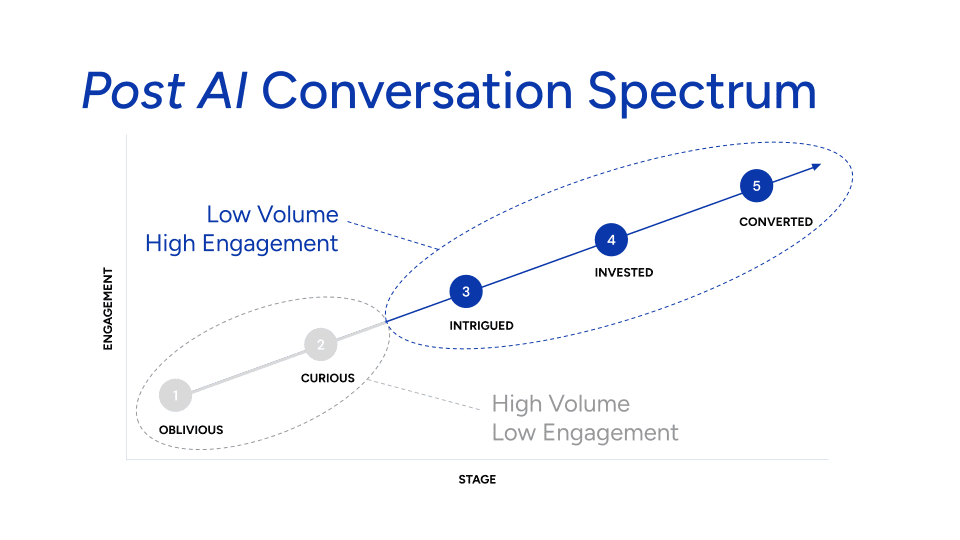
AI is increasingly answering the Oblivious and Curious questions directly, with no click required. “Why does my head hurt” and “what causes migraines” are exactly the high-volume, low-commitment questions that get resolved right inside the chat window. So the traffic you used to earn from that early-stage content is dropping. (If that decline has you worried, we wrote about why it looks scarier than it actually is.)
Should you stop writing early-stage content, then? Not necessarily. If your organization is well indexed and frequently cited by AI, that content still earns its keep by shaping the conversation even when nobody clicks. When the AI explains migraines, you want it to explain them with your information. That’s influence, visit or not.
The latest horizon is where opportunity lies. AI is very good at answering questions. It is not (yet) good at doing things. It can’t order the medication, book the clinic, complete the enrollment, or become a member on someone’s behalf. Those are Intrigued- and Invested-stage actions, and they still need a human to act.
Which means AI is shaping up to be the best referral partner you could ask for. It fields the early, low-intent questions itself, then hands the people who are ready to act – the most qualified, highest-intent traffic available – straight to whoever has the best action-oriented content. We’re already seeing it: across our clients, AI-referred visitors tend to show up more engaged and more ready to move than visitors from other sources.
Of course, in keeping with our conversational metaphor, this means you’re picking up a conversation part way through. You have to consider the context, and ensure what you’re saying is appropriate for where they are in the spectrum. Confirm they’re in the right place, and provide an obvious, friction-free next step to take.
Early-stage content is now mostly about being cited. Late-stage content is about being chosen. Put your best energy into the Intrigued and Invested pieces, and make the path from “I think this is for me” to “I’m in” short and clear.
And then there’s what happens after
We left Converted as a cliffhanger on purpose, because it deserves its own conversation.
If you’ve read this far, you likely agree that getting someone to sign up, join, or buy isn’t the finish line. They aren’t deals to be closed. They are new relationships that get opened.
It isn’t an easy needle to thread – you’ve got to avoid overpromising and overhyping yourself in the marketing (or advertising) side of things so expectations aren’t through the roof, while also making sure people know it is good enough to be convinced to actually take the next step.
Once they’re in, you’re wrapping up the “selling” experience, and are starting the “getting” experience. Nail both and you’ve earned something no ad budget can buy: a real review, a referral, a member who renews without a second thought. But don’t be one of the ones that immediately burns that goodwill by nagging, begging, and souring a perfectly good experience by overreaching at the very end. Alas, this is a chat for another day – if it is something you’re concerned about, we recommend Never Lose a Customer Again.
For now, start by mapping one of your own spectrums. Pick a problem your organization solves and write out the questions a real person commonly asks you at each stage, Oblivious through Invested. Then read it back as if they’re sitting across from you, or ask someone with a similar problem to read through it for you. You’ll be surprised how easily the gaps stand out to you. Where your attention starts to drift, or you find yourself reaching for another tab instead of scrolling. Boom, that’s where you build in your pivots.
From there, tools like Google or Matomo Analytics, and platforms like Hotjar or Crazy Egg can help you better see how people are finding you, and where you may be losing them, helping you to better hone each article or video into the conversation that’s just right for you and your audience.
As always, if you’ve got questions about any of this, or want a hand mapping it for your organization, we’re happy to connect and chat. Just reply to this email or reach out here.
###
*The one big exception is Eugene Schwartz’s old “stages of awareness” framework from the copywriting world. He has the right spirit, but is looking at it from a more mechanical perspective. It is one of the reasons his model has aged so well, and is certainly one of the giants on whose shoulders we stand. Credit where it’s due.
Latest Posts

Your website’s biggest audience isn’t people anymore
tl;dr: It was only a matter of time – machines are now visiting websites…

15 Minutes to Spare You a REALLY Bad Afternoon
Three things you can do in under five minutes each to protect your site,…
Your Association’s Website Has Three Jobs in 2026. Most Are Doing One and a Half.
My TikTok feed recently served up a video about well paying, in-demand careers that…
Keep Reading about Your Association’s Website Has Three Jobs in 2026. Most Are Doing One and a Half.