
Do Less.
AI enables us all to do “more” – that’s the problem.
You started the day with fourteen things on your to-do list. It’s late afternoon now, and you’ve taken care of ten of them. Real ones, too, not the “make checklist” stuff you add just so you can feel good about crossing something off. So far, a good day’s work.
Until you checked your inbox. And Slack.
Now your to-do list has nineteen items on it.
If this was a one-off anomaly, you’d shrug it off and come back to fight another day. But it isn’t an anomaly, it’s the “new normal.”
AI has enabled us to do “more,” and we seem to take it for granted that the “more” is worth doing.
The three kinds of “more”
- The first kind is the one at the heart of Shiny Object Syndrome (SOS) – the bright and shiny distraction. The idea that is obvious-in-retrospect but irresistible in the moment; the tool you had to try, the little thing that would save you a few minutes per week but has now taken over 4 hours to build. All too easy to identify and laugh about once they’re in the rearview, but feel so sticky in the moment.
- The second kind is more dangerous, because it looks like good strategy. We call it going wide. AI suddenly makes it plausible to expand into the things adjacent to what you already do. It’s a defensible argument. We already do this, why don’t we also offer that. Unfortunately, the same tool handed everyone else the exact same opportunity. Much like a military unit exceeding its supply line to acquire a “target of opportunity” only to find themselves overextended and cut off. Victory in battle today can lose the war tomorrow. Don’t take the bait.
- The third kind of “more” is a kind of “less.” Don’t do “more” and go wide, do “more” by going deeper. Do the thing you already do best, better. In a way that no one, even bolstered by these new tools, can rival you. This requires discipline, an undervalued commodity in an AI-driven landscape.
Doing “less” is worth more
There are two major reasons this is true. The first is psychological; simply give yourself permission to do less.
The second reason is strategic. AI can only be trained on information that already exists. It can pore through existing data, exchange it, and process it in ways no human can. But it doesn’t know the latest news, the most recent breakthrough, the novel system or process you’ve created until it has access to it.
While there are legal discussions in progress about what kind of compensation may be owed to the original creators of information AI uses, the outcome of those cases and debates are far from clear right now. Regardless of those outcomes, you may find that your organization doesn’t feel like putting its information out in the open is a fair trade anymore. We’re already seeing the open web starting to retreat back behind walled gardens; AI can’t use what it doesn’t know.
In short, you have the ability to lean further and further into your unique advantage.
The Hedgehog and Fox
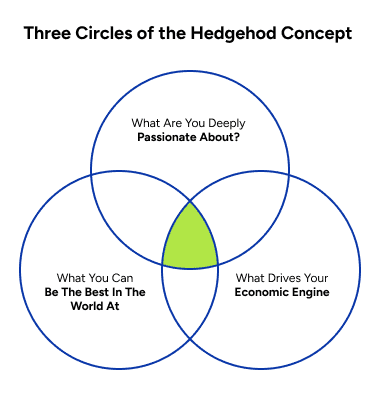
In Good to Great, Jim Collins reminds us that “the fox knows many things, the hedgehog knows one big thing.” The Hedgehog Concept. It’s the overlap of three questions. What can you be the best in the world at? What actually drives your resources? And what do you genuinely care about most? The thing sitting in the middle of all three is your hedgehog, and the discipline is saying a polite no to everything outside it, including the good opportunities. (People also refer to the concept of Ikigai – which, as it turns out, isn’t really the Japanese intention for the word, it kind of got stapled onto an artist’s diagram. Nonetheless, it is a helpful little graphic.)
Real world examples of “less” creating more
- The American Association of Endodontists could use AI to accelerate production and publish endlessly about every corner of dentistry. They don’t. They know what they are focused on – saving your natural teeth and the procedures they are the world class experts at. They go deeper on the thing they fully own, root canals, what it is, how it works, why it matters.
- As a result, despite the fact that AI is reducing website traffic by about 42%, AAE continues to see more traffic year over year to the most important facet of their online presence – their member directory, which connects endodontists with the patients who need them.
- The College Funding Coach works in financial management and advice space. A field sprawling in a hundred directions at once. Their team could easily use AI to chase all the various financial topics. Instead, they remain fixated on their core founding mission – how to send your kids to college without going broke.
- As a result, despite search traffic cratering in the financial space, The College Funding Coach continues to bring in more traffic to their site year over year. Not through publishing 1,000 articles or spamming social media and email, but by focusing on and developing relationships with and within the communities they support.
- EMDRIA has experienced significant growth over the last several years as EMDR therapy has grown in popularity. Some organizations would have overreached, cutting themselves into sub-disciplines and practices, or attempting to use their momentum to become a more general mental-health resource. Instead, they’ve doubled down on the things that matter most to their members and the public at large – their resource library and their member directory, connecting certified therapists with patients.
- As a result, they too have seen year over year growth in traffic to their website despite universal trends in web traffic. Their directory continues to see significant growth, helping more people connect with and benefit from this incredible therapeutic modality.
Despite our preponderance of examples, this behavior is not the norm. More organizations are in a frenzy to do more – fueled by the capabilities of AI, and the fear of the very same. The media continues to forecast impending doom and predict the “winners” and “losers” in an era of AI.
The quickest way to lose is to buy into the hype and burn yourself out chasing prizes that aren’t worth catching.
So, do less
Give yourself permission to reconsider that ever-growing to-do list. Are those tasks the ones that really move you, your organization, or the world forward? Or are they the kind of “more” that feels so important in the moment, but will leave you wondering why you were so worried about it when you look back on these moments?
Give yourself permission to do less, with intention. It may be the shortest path to “Better.”
Mahalo,
Chris & the Yoko Co team

PS – I wrote an article for CIO Magazine, and would love for you to check it out: The best workplace culture in America is being built by companies you’ve never heard of(opens in new tab)
—
What’s Good?
This month we’re celebrating those who are helping new people navigate their field and discover their career paths.
- All stories are histories, and so we start off by shouting out the people recording and telling these stories – American Historical Association and their member Hannah Peckham(opens in new tab)
- Our friends at the Society for Biopsychosocial Science and Medicine give a shout out to Manuel Ramirez(opens in new tab), a PhD student focused on social stigmas and their impact on health.
- Our friends (with a new website btw) at Northern Virginia Construction Careers Coalition celebrate Tucker’s leap from high school to joining Ennis Electric(opens in new tab)!
- Last on this list (though certainly not last in our hearts), is the American Oil Chemists’ Society (it’s probably not what you think) and their spotlight on Thilini Dissanayake(opens in new tab)
People helping people. You love to see it.
(We love good news, so if you have some, please contact us(opens in new tab) and use the form to share it with me!)
Latest Posts
Your website’s biggest audience isn’t people anymore
tl;dr: It was only a matter of time – machines are now visiting websites…

15 Minutes to Spare You a REALLY Bad Afternoon
Three things you can do in under five minutes each to protect your site,…
Your Association’s Website Has Three Jobs in 2026. Most Are Doing One and a Half.
My TikTok feed recently served up a video about well paying, in-demand careers that…
Keep Reading about Your Association’s Website Has Three Jobs in 2026. Most Are Doing One and a Half.