
tl;dr: It was only a matter of time – machines are now visiting websites more than people are. A lot of that traffic is AI. Some with more honest and mundane intentions, others far more malicious. Bad actors probe your site for weaknesses, data leaks, or simply scraping contact info to spam, phish, and scam. The better actors are reading, summarizing, and, more frequently, acting (often agentically), on your content. This trend foretells of the web that is to come, and the orgs that embrace it now will be best positioned to make the most of it.
By the numbers
Thales 2026 Bad Bot Report, summarizing 2025, estimates 53% of all internet traffic was bots. While I hesitate to hang my hat on any single source’s numbers, I knew even if their data was debated (it was), we were approaching an inevitable turning point.
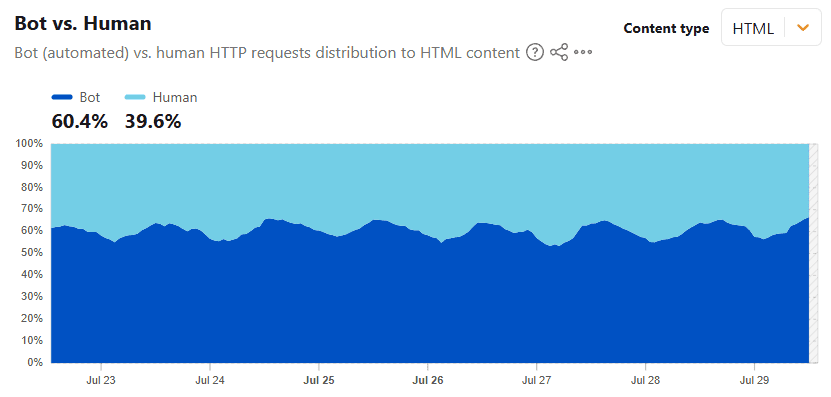
This summer, Cloudflare’s Radar dashboard showed bots passed humans as the most active entities on the web in June. Solidifying the fact that we are now firmly in a new era of the web. As of the date of writing this, Cloudflare’s radar shows current web traffic at 60.4% bots : 39.6% human. Over time that ratio will continue expand, with bot traffic eventually growing to become orders of magnitude greater than human traffic.
What are the bots doing?
There are still all the bots we’ve loved before – search engine crawlers, uptime monitors, archival tools, and myriad others. They’re just being used at a scope and scale we’ve never seen before. So are their more malicious cousins – the rate of cyber attacks has increased precipitously, from your run-of-the-mill DDoS or AI enabled phishing attempts to far more advanced probing for vulnerabilities and laddering them together into sophisticated attacks, like the recent OpenAI/Hugging Face debacle. (Oh wait, it got worse.)
Of course even more of these bots are acting, well-intentionally, or, at least neutrally, on behalf of users and organizations. A user enters a prompt or query to their AI of choice and as it attempts to fulfill the user’s request it may visit dozens of sites, yours among them, pull what it needs and provide the user with an answer.
Without the user ever seeing your site. They get whatever the AI decided was worth sharing.
The information you provide is now being read more by machines relaying partial information back to a human (or another AI) secondhand.
Our mental models of machines are out of date
We think of computers as machines – and machines, in the classical sense, were mechanical. A piston goes up and down, a gear turns, they follow physical laws we can see. However, modern neural networks are a far cry from the machines of old. They’re a black box with too many variables for us to predict, or, currently, fully understand.
Yet we still think of them as classic machines – put the same inputs in, get the same outputs out.
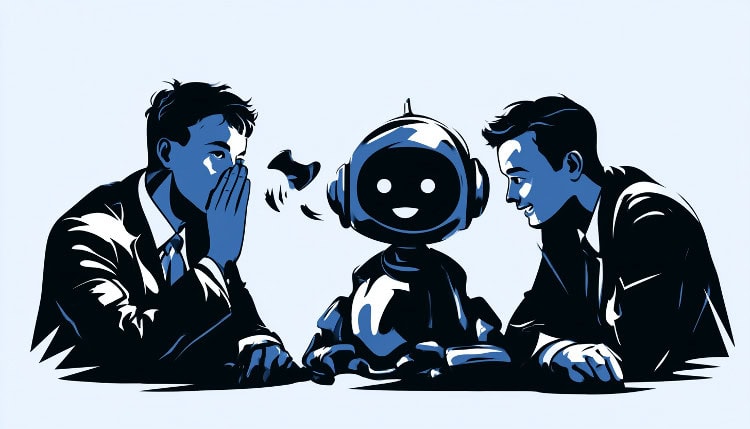
That is not true in the era of AI. These models are stochastic, not deterministic. Which means even with consistent inputs, you’ll get different outputs. If you’ve ever played the game “Telephone” with a group, you know how easy it is for information to be misinterpreted. A key bit of context is missing, a word changed for a synonym, or a critical negative is skipped, turning a “no, thanks” into “thanks” and thereby inverting the intended meaning.
The middle man dilemma
When someone asks an AI model a question about your organization, industry, product or services, the answer is, increasingly, coming from a middle man. (Ok, I suppose “man” is a misnomer in this case.) Your info is mixed in with everything else the model learned during training. Some of it is outdated, some of it may be about a different organization with a similar name, some of it is incorrectly paraphrased, or straight up hallucinated.
You can influence how these models see you, and what they say about you, but you have no direct control over them.
You know what you do have direct control over though?
Your own AI models.
There are two reasons we believe this is worth exploring sooner than later:
First, it’s the best mirror you’ll ever hold up to your own content. Incorporate an AI with only your material and start asking it questions the way your audience would, you’ll learn a lot, and quickly.
- Which questions fall into your blind spots and have no answers.
- Where your information is thin, and needs to be fleshed out.
- Where you contradict yourself.
- Where historic information isn’t appropriately contextualized or weighted.
- And so, so much more.
An AI trained on your content answers from your facts, not a blurry average of the whole web. Seeing how it answers will inform your content and communications strategy in a practical way that well intentioned planning sometimes misses.
Second, it prepares you for where this is all going. The agentic web isn’t going to stop at “AI reads your site.” The next phase has already begun – AI transacting with AI. A prospective member’s assistant contacts your assistant to ask about eligibility and sign them up. A supporter’s AI handles the donation. A patient’s AI checks your hours, your services, and books the appointment.
The organizations already armed with their own AI, integrated into their ecosystems with access to a comprehensive index of their information, are the ones who will be prepared to have those conversations. Everyone else will be rushing to build it under pressure, chasing the competitors who were better positioned to embrace the future.
This is a good problem (for you) to have
If you’re a mission-driven organization, this shift actually plays to your strengths. You’ve spent years (maybe decades, or even centuries) building genuine expertise, trust, and authority. An AI trained on everything you have to offer will serve as a force multiplier. The hard part is getting all your information in order, indexed, and shaping what you want your AI to be able to say and do. (In a future article we’ll talk about our collaborative approach to building and training AI with our clients.)
There are a number of options in how you can integrate a public facing AI with your website. We’ve been helping organizations do this since generative AI became available (hard to believe that was only 4 years ago).
Here are a few examples in the wild to help you explore some of the possibilities:
- For NASCIO, we built AI-powered semantic search with facets and filters. It matches on intent, automatically corrects misspellings, and summarizes results.
- For the EMDRIA Library, we built real-time AI indexing with live filtering. Results and thumbnails update instantly as users refine their search, no page refresh or delays.
- For AAEP’s Ollie Bot, we built conversational, chat-based search that supports longer, back-and-forth threads for more complex questions.
- For ACHA, we built federated search, pulling results from multiple systems and content sources at once, with AI providing suggested searches and summaries.
- For SNA, we built Trey, a narrowly trained event assistant that helps members navigate and prepare for their Annual National Conference.
The options vary, and what is right for you will probably be different from what is right for someone else. But there is no doubt in my mind that the more adept you are at leveraging these tools now, the better off you’re going to be when they’re the ones primarily engaging with other people (or, more accurately, other bots) on your behalf.
If it’s something you’ve been meaning to get around to, or you’re not sure where to start, we’re happy to connect and share information with others who aim to have a positive impact on the world. No pressure, no pitches, no 1,000 follow-up emails and texts and LinkedIn comments hassling you ad nauseam. Just a couple of humans talking to each other. Maybe even in person. Like they used to do in the 1900s. Alas, ‘twas a simpler time.
Of course, if you’re not ready to talk to a person, you can always talk to our AI 🤖
We hope this helps!
Mahalo,
Chris & the Yoko Co team
PS – We’re bringing Association Feud to ASAE Annual. Think Family Feud, but for people who know what a bylaw is. Now, this only works if we have answers. And right now the board is about half full. That’s where you come in.
Take our quick survey and tell us what you really think about association life. Your answers become THE answers. The ones we’re hoping people slap the buzzer and shout out at the booth. It only takes about two minutes. No wrong answers… which, if you’ve ever played Feud, you know is a beautiful lie.
Then, if you are in Indy, come find us at Booth 110 to see if your answer made the board. Winner gets bragging rights and the deep satisfaction of beating a stranger at a game about surveys!
—
What’s Good?
The latest impact stories from the worlds of our clients.
- The folks at WWF’s Climate Crowd announced six new pathways to support wildlife resilience in a changing climate
- Our friends at NAMIC supporting the reestablishment of FEMA as an independent agency and enabling it to better support and assist the public before and after emergencies
- In the wake of the resurgence of measles, our friends at NFID announced the creation of the Measles Collaborative to help educate and communicate about the risk and options to prevent measles, and renew efforts to eliminate it.
(We love good news, so if you have some, please contact us and use the form to share it with me!)
Latest Posts

Your Association’s Website Has Three Jobs in 2026. Most Are Doing One and a Half.
My TikTok feed recently served up a video about well paying, in-demand careers that…

15 Minutes to Spare You a REALLY Bad Afternoon
Three things you can do in under five minutes each to protect your site,…
Do Less
Do Less. AI enables us all to do “more” – that’s the problem. You…
Keep Reading about Do Less